Practical animal care beyond the pet-store card—built from published research, veterinary guidance, natural history, and responsible keeper experience, with room to say when the evidence is still incomplete.
Many employees care deeply, but short sales-floor cards, inconsistent training, outdated product claims, and pressure to keep advice simple can produce incomplete guidance. Verify important decisions with current sources and an experienced exotic veterinarian—not one employee, one video, or one package label.
02
Evidence gets a label here.
Published evidence Peer-reviewed study or documented field observation.
Veterinary guidance Clinical or professional welfare recommendations.
Keeper experience Useful practical observation that does not become proof through repetition.
Sakura Hollow’s public position
Do not make a lifelong care decision from pet-store advice alone.
Respectfully: do not treat a pet-store employee as your final authority on animal care. Some employees are knowledgeable and compassionate. Others may have only a short company care card, limited species training, old information, or products they are expected to sell. A confident answer at a counter can still be incomplete or wrong.
Listen politely, write down what you are told, and then verify it before acting—especially enclosure size, heat, humidity, UVB, substrate, social housing, diet, supplements, and medical claims. Cross-check the exact species with published research, qualified exotic-veterinary guidance, welfare organizations, experienced specialist keepers, and measured conditions in the enclosure.
This is not an attack on retail workers. It is a warning about a system that can reduce a complicated living animal to a starter kit and a one-page sales card. The animal carries the consequences after the receipt is gone.
Two claims that deserve nuance
Possible is not the same as recommended.
Leopard gecko cohabitation
We do not recommend routine cohabitation.
Field literature describes loose aggregations, and research colonies have kept certain females or established pairs/groups together. That shows peaceful coexistence can occur; it does not prove that a typical pet enclosure makes it safe. Leopard geckos are still described in behavioral research as typically asocial, and aggression, breeding pressure, resource guarding, unequal feeding, and subtle chronic stress can be missed.
If an advanced keeper chooses to attempt it, the enclosure needs substantially more usable space, repeated hides across every temperature and humidity zone, separated food and water stations, verified sexes, individual weight records, close observation, and a complete ready-to-use backup enclosure. Never house adult males together. Separate immediately for chasing, biting, guarding, weight loss, injuries, or one animal repeatedly hiding.
Adam Wickens has publicly shown and discussed keeping multiple leopard geckos together, including in his official video “I Made a Huge Mistake. I Should Have Done This Instead!” ↗, which revisits his leopard-gecko cohabitation setup. That makes his work a useful, visible keeper case study and a reason many people are now debating the subject. It is not a controlled welfare study, and it does not cancel the risks or single-housing recommendations from welfare guidance. Sakura Hollow credits the conversation while independently checking every husbandry claim.
Evidence note: The available studies document natural aggregation or captive group housing; they do not establish routine cohabitation as the safest pet-care standard. The RSPCA recommends keeping leopard geckos singly, while newer peer-reviewed work supports richer, naturalistic environments for individually studied geckos.
Bearded dragon lighting
UVB is essential. “Linear” is a tool, not the biological requirement.
A bearded dragon needs an appropriate ultraviolet index at the basking site, enough illuminated area to expose the body, and the ability to move into lower-UV and shaded areas. A quality linear fluorescent fixture is often the most reliable way to create that usable zone in a normal enclosure—but the animal’s biological need is correctly measured UVB, not a particular tube shape.
Do not flood the entire enclosure with peak UVB. Group basking heat, bright visible light, and UVB at one end, then provide a cooler, shaded refuge. Mesh, distance, reflectors, fixture output, and bulb age all change what reaches the dragon. A narrow or weak compact bulb should not be assumed adequate simply because the box says “UVB.”
Evidence note: Published UV guidance uses species-relevant UVI and a light-to-shade photogradient; lamp choice must produce that environment safely.
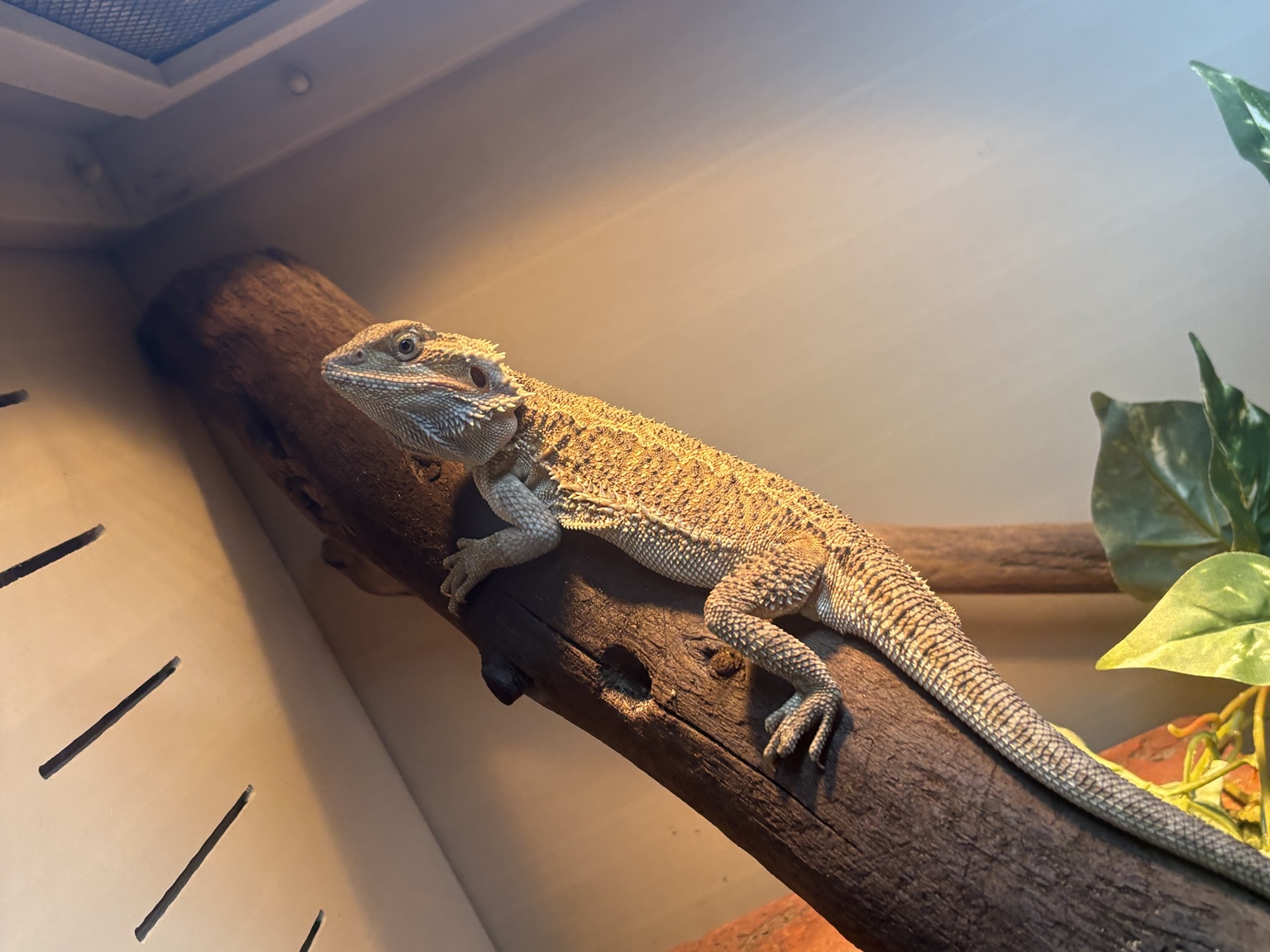
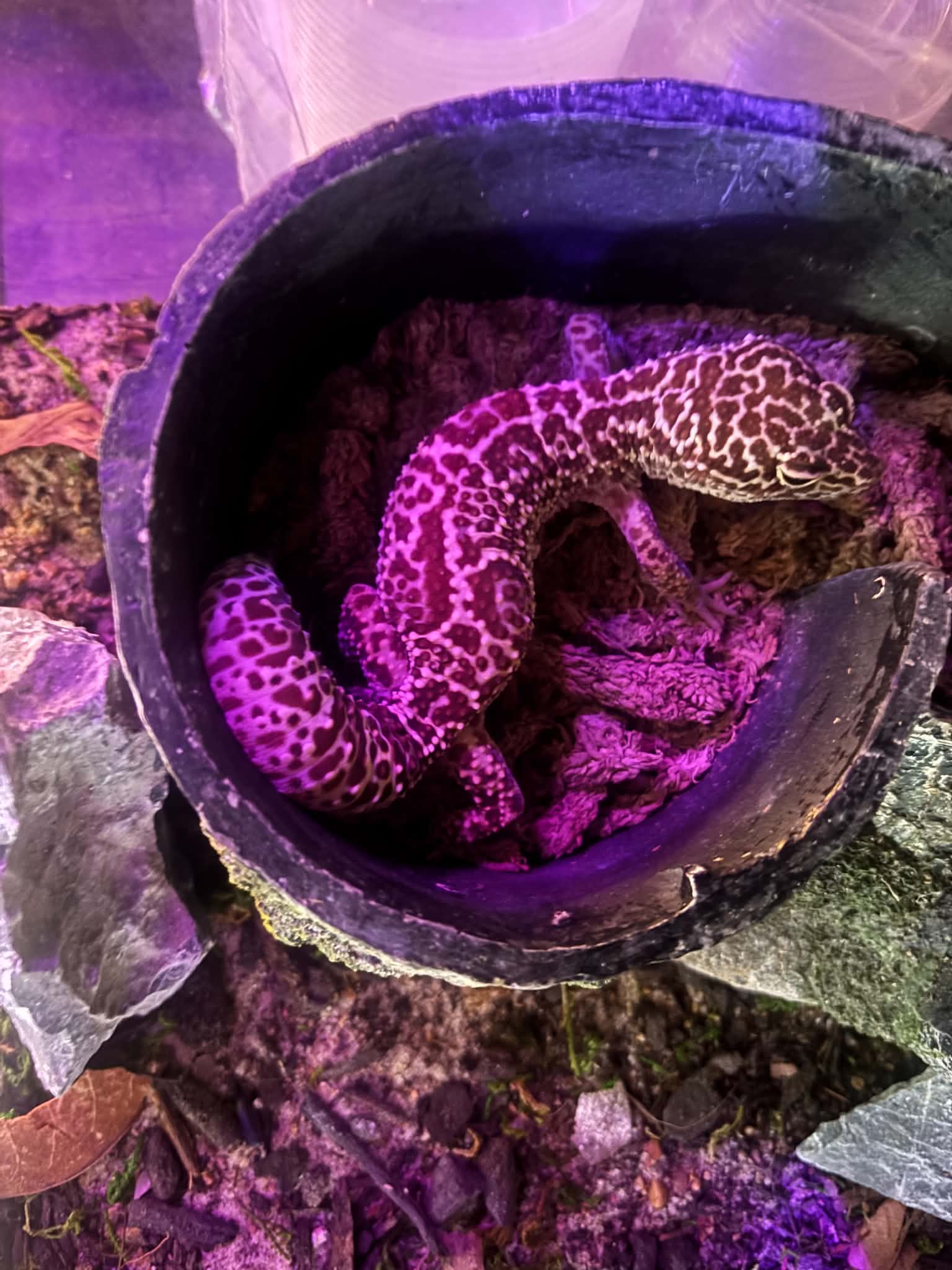
A real look inside Sakura HollowOne of Brendan’s actual residents—not a stock or generated image.Meet NebulaA second genuine resident photograph. The rest of the sanctuary stays a surprise for visitors.
Keeper-to-keeper field notes
Learn the animal before you buy the setup.
Think of these as the important stuff one keeper would point out to another—not a one-size-fits-all recipe. Health, age, sex, morph, room climate, enclosure design, and the conditions you actually measure can all change the plan.
Real Sakura Hollow residentBrendan Martin · Sakura Hollow resident
01
Reptile · Intermediate
Bearded dragon
Give them more floor room than height, but add solid branches, rocks, and somewhere they can dig. They will use it.
Build one proper basking area with measured heat, bright light, and UVB. Keep the other side cooler and shaded so the dragon gets a choice.
Adults need varied leafy greens, with gut-loaded insects offered on an age- and body-condition-appropriate schedule. Calcium is useful, but guessing the dose is not.
What a sales card may leave outDo not trust the picture on a bulb box. Check the basking temperature and, when possible, measure UVI where the dragon actually sits.
Real Sakura Hollow residentBrendan Martin · Nebula at Sakura Hollow
02
Reptile · Beginner-friendly, not effortless
Leopard gecko
Use several snug hides instead of one favorite cave: warm, cool, and humid options let the gecko choose without feeling exposed.
Provide fresh water, varied gut-loaded insects, gentle UVB, and a place where the gecko can get completely out of the light.
A healthy adult can do well on a suitable natural soil-and-sand style substrate when heat, hydration, and nutrition are correct.
What a sales card may leave outLoose substrate is not automatically an impaction sentence. Bad material, low heat, dehydration, poor nutrition, or an unhealthy gecko are the bigger conversation.
Think upward: branches, cork, vines, and leaves should make most of the enclosure usable, not just the glass walls.
These geckos handle moderate temperatures better than excessive heat. Give them a normal day/night light cycle and watch summer room temperatures closely.
Use a complete crested-gecko diet and offer appropriate insects for variety. Fruit baby food is not a balanced staple.
What a sales card may leave outA tall empty tank with one fake vine and a food cup technically holds a gecko, but it does not give an arboreal animal much of a life.
Use a secure enclosure long enough for the snake to stretch out. Add snug hides and plenty of cover so moving around does not mean crossing open ground.
Control the warm and cool areas, maintain suitable humidity, and keep clean water available. Measure the enclosure instead of judging it by touch.
Offer correctly sized whole prey—usually frozen-thawed—and adjust the schedule by age, weight trend, and body condition rather than begging behavior.
What a sales card may leave outA ball python can stay alive in a small tub. That does not mean it should lose the chance to stretch, explore, climb, and choose where it feels comfortable.
Corn snakes are talented escape artists. Use secure housing with enough length for the snake to fully straighten out.
Give them a warm area, a cooler area, several hides, branches, and substrate deep enough to burrow through.
Feed correctly sized whole prey and watch the snake’s body shape over time. A feeding chart is a starting point, not a reason to ignore weight gain.
What a sales card may leave outThey are often sold as simple ground snakes, but corn snakes climb, burrow, and investigate when the enclosure actually gives them the option.
These tortoises need a surprising amount of floor space, deep soil for digging, strong lighting, and a plan for seasonal changes.
Base the diet on fibrous broadleaf weeds and appropriate greens. Fruit is not a regular menu item.
Measure basking heat and UVB, then leave cooler shaded retreats. Being a sun-loving species does not mean being unable to escape the sun.
What a sales card may leave outA glass aquarium and a pile of grocery-store lettuce may look convenient, but neither comes close to a complete tortoise setup.
Use a tall, ventilated habitat with sturdy perches, plenty of cover, and clean dechlorinated water.
Keep humidity in the right range without turning the enclosure into a permanently wet, stagnant box. Moisture and ventilation have to work together.
Offer varied gut-loaded insects. Handle only when necessary, using clean wet hands or clean, wet, powder-free gloves.
What a sales card may leave outA frog’s skin is part of how it interacts with its environment. Lotion, soap residue, dirty water, and constantly stagnant conditions are not small details.
Use a secure, ventilated enclosure that does not open through the spider’s usual web hammock at the top.
Provide texture and anchor points for climbing, gentle hydration, and live prey sized so the spider can safely handle it.
Watch appetite, abdomen shape, web-building, and molts. Those observations are more useful than following a fixed feeding schedule without adjustment.
What a sales card may leave outSmall size does not make care risk-free. A gap, a fall during a molt, or prey that is too large can become a serious problem quickly.
First determine whether the species is terrestrial, burrowing, or arboreal. Those are three very different enclosure plans.
Match substrate depth, fall distance, hides, water, and ventilation to that lifestyle. A terrestrial tarantula should not be able to fall far.
Handling is rarely worth the risk. A short drop can injure the tarantula, and defensive hairs or a bite can injure the keeper.
What a sales card may leave outHumidity does not mean swamp. Species, life stage, substrate moisture, and ventilation all matter more than spraying everything every day.
Provide deep moisture-holding substrate, tight hides, ventilation, and a shallow clean water dish. Let the scorpion dig.
Keep temperatures stable with a safely controlled heat source. Hot rocks can burn animals and should stay out of the enclosure.
Feed suitable live prey in reasonable amounts, remove leftovers, and make observation the main form of interaction.
What a sales card may leave outNot every large black scorpion in a store is an emperor scorpion. Confirm the species before copying a temperature or humidity number from a care sheet.
Before one comes home
The animal should not arrive before the habitat is proven.
Identify the exact species.Common names and pet-store labels can cover animals with very different needs.
Build and run the enclosure first.Log heat and humidity for several days; measure UV at animal level when applicable.
Price the full lifespan.Include electricity, replacement lamps, food, substrate, testing tools, and exotic-vet care.
Plan quarantine.New arrivals need separate tools, hygiene, observation, and veterinary help when indicated.
From Brendan’s actual care log
What a day at Sakura Hollow can look like.
This is a working example—not a commandment. Every keeper’s timing, household, climate, enclosure, and animals are different. Use it to make care easier to remember, then build a routine around the needs of your own animals and your veterinarian’s guidance.
Copy the habit, not necessarily the clock.Consistency, observation, measured conditions, and written notes matter more than matching Brendan’s exact times.
Water, food, conditions, and eyes on every animal.
Feed and refresh water for the dogs and ducks.
Offer dragons fresh greens and dechlorinated water.
Mist frogs and check their water.
Check water for Genke, tarantulas, scorpions, and jumping spiders.
Read temperature and humidity, spot-clean, and look for changes in posture, appetite, movement, waste, or behavior.
Helpful idea: Do the round in the same order so a skipped enclosure feels obvious.
A consistent light-and-heat day.
Brendan’s dragon schedule runs heat, bright daytime lighting, and Arcadia T5 UVB during this window. The enclosures still provide shaded and cooler choices so the dragons can regulate their own exposure.
Helpful idea: A timer creates consistency, but thermometers and UVI measurements tell you what the animal actually receives.
Feeding is scheduled by animal—not by convenience.
Genke: Monday, Wednesday, Friday, and Sunday at 7:00 PMDragon insects: Tuesday and Friday at 6:30 PM, using calcium without D3 in Brendan’s recorded planWhite’s tree frogs: Monday, Wednesday, and Saturday at 7:30 PMArachnid/scorpion feeding check: Saturday at 8:00 PM
Helpful idea: A feeding “check” does not always mean feed automatically—molting, body condition, uneaten prey, and species needs come first.
Supplements, cleaning, and the week ahead.
Weekly reptile multivitamin is scheduled for 8:30 AM.
Cleaning and supply checks begin at 9:00 AM.
Refresh water, spot-clean or service enclosures as needed, and check food, substrate, supplements, bulbs, and other supplies before they run out.
Arachnid cleaning stays conservative: remove visible remains and waste without needlessly destroying webbing or burrows.
Helpful idea: Put supply checks on the calendar before an empty container turns into an emergency.
Why logs help
A record shows what actually happened—not what you meant to do.
One Sunday dragon log recorded fresh dechlorinated water, greens, and spot-cleaning, with no insects or supplements that day; evening handling was planned, and the next day’s insect meal used calcium without D3.
Another care log recorded gecko supplements, water changes, and spot-cleaning; daily frog misting with insects fed that day and the next feeding planned two to three days later; mallards bathed, dried, and returned to their room; plus fresh arachnid water, visual checks, and visible-remains-only cleaning.
The lesson is not to copy every task. The lesson is to record food, supplements, water, cleaning, behavior, and the next planned action so double-dosing, missed care, and unexplained changes are easier to catch.
Call an experienced exotic veterinarian promptly for:trouble breathing, collapse, severe injury, seizures, uncontrolled bleeding, prolapse, repeated vomiting, egg-binding signs, major swelling, inability to use limbs, or a rapid unexplained decline. This library provides husbandry education—not diagnosis or treatment.Find an ARAV veterinarian →
Read past the headline
Sources, corrections, and credit.
Claims are checked against original studies and qualified animal-health or welfare guidance whenever available. Research evolves, and recommendations may change as better evidence appears.
Textbook knowledge should still make sense in a real reptile room.
These creators are useful because they show enclosures, routines, mistakes, debates, and changing husbandry in practice. Sakura Hollow does not treat any channel as automatically correct. Their job here is to add keeper context; studies, veterinary sources, welfare guidance, and measured conditions still settle factual claims.
How to use YouTube responsibly: Look for creators who show measurements, explain tradeoffs, correct old advice, name their sources, and admit uncertainty. Never copy a setup from a video without checking the exact species and the conditions in your own enclosure.

.jpg?width=1200)


_crop.jpg?width=1200)


